
You just wrapped one of your best projects.
Maybe it’s a whole-home addition in a neighborhood you’d love to work in again. Maybe it’s a kitchen that took six months and turned out better than anyone imagined. The clients are thrilled. The photos are stunning. Your crew did exceptional work.
And then what happens?
The photos go into a folder. Maybe a few make it to Instagram. Your office manager uploads the best ones to your portfolio page. You move on to the next project.
Meanwhile, somewhere in your market, a homeowner is sitting at her kitchen table at 10pm typing “home addition contractor Northern Virginia” into Google. She’s done the Pinterest boards. She knows what she wants. She has the budget. She’s ready to call someone — probably this week.
She’s not finding you.
Not because your work isn’t good enough. Not because you don’t serve her area. But because Google doesn’t know your best project exists.
The problem with how most remodelers handle completed work
Most remodeling websites treat completed projects in one of two ways.
The first is the photo gallery — a grid of beautiful images with maybe a one-line caption. “Kitchen remodel, McLean VA.” It looks great. It does almost nothing for search.
The second is the portfolio page — a slightly more organized version of the same thing. Better than nothing, but still built for humans who are already on your site, not for Google to find and surface to humans who aren’t.
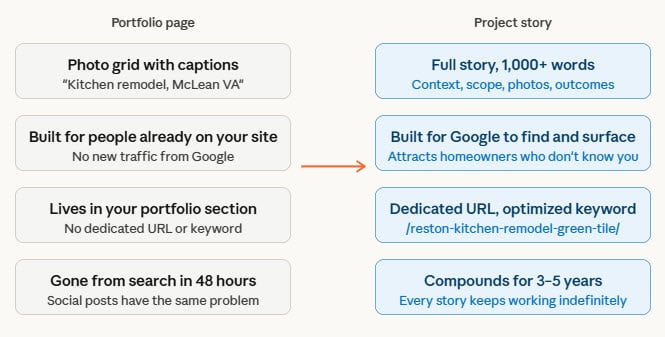
Here’s what neither of those approaches does: they don’t give Google a reason to show your work to someone who doesn’t already know you exist.
Google needs words. Specific words. Location words. Project-type words. The kind of words a real homeowner types when they’re 90 days away from signing a contract.
What a project story actually is
A project story is a dedicated page on your website that documents a single completed project — written specifically to be found by people searching for exactly that type of work, in exactly your market.
Not a gallery. Not a caption. A full page.
It tells the story of the project — the homeowner’s challenge, what you designed, how you built it, what made it complicated, and what made it exceptional. It includes the photos, yes — but properly optimized, with alt text that tells Google what it’s looking at. It includes the location, the project type, and the scope. It’s built the way Google needs content to be built to understand what it is and who should see it.
And then it sits on your website, working quietly, for the next three to five years.
What this looks like in the real world
I work with a design-build remodeling firm in Northern Virginia — kitchens, home additions, aging-in-place remodeling, basements. Good firm. Excellent work. Their clients refer them constantly.
Over the past year, their project portfolio pages generated 713 sessions in a single 30-day period. But what matters more than the number is the behavior of those visitors — a 26% bounce rate and an average session duration of over two minutes. These aren’t people who landed and left. They’re people who arrived looking for something specific and stayed to read.
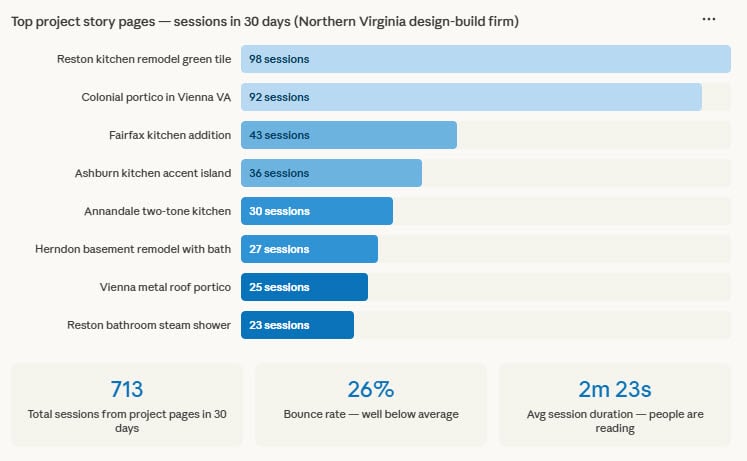
Look at what those pages are titled:
- /reston-kitchen-remodel-green-tile/
- /fairfield-kitchen-addition/
- /herndon-basement-remodel-with-bath/
Location. Project type. Specific detail. That’s not an accident. That’s a homeowner in Reston searching for kitchen remodelers, finding a page about a real kitchen remodel in Reston, and spending a minute and fourteen seconds deciding whether to pick up the phone.
The second example is a custom home builder in Pittsburgh. Their project stories tell a similar story. Pages like “Custom Built Modern Farmhouse in McDonald, PA,” “Craftsman Style Home in Venetia,” and “Pittsburgh Spec House in Upper St. Clair” are pulling consistent traffic from people searching by location and project type.
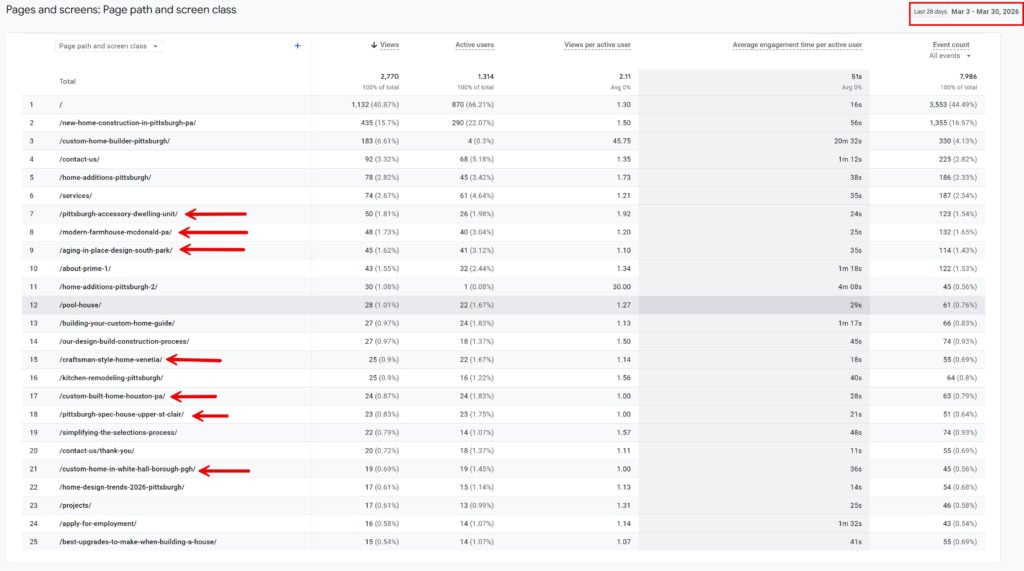
These aren’t generic portfolio entries — they’re specific, named, located stories about real projects. And they’re being found by people who are searching for exactly that kind of work in exactly those neighborhoods.
Why this works when generic blog posts don’t
There’s a reason I’ve shifted away from recommending monthly blog articles as the primary content strategy for remodelers.
Generic content — “10 kitchen remodeling trends for 2026,” “how to choose a contractor,” “the benefits of design-build” — is now produced at scale by AI tools, published by thousands of websites, and increasingly filtered out by Google’s own algorithms. It’s getting harder and harder to rank for, and the traffic it attracts is often early-stage and not ready to buy.
Project stories are the opposite. They’re specific. They’re local. They’re evidence of real work done in real places. Google rewards specificity. And the homeowner who searches “whole home remodel Bethesda MD” and finds your story about a whole home remodel in Bethesda? She’s not in research mode. She’s in decision mode.
That’s the traffic that turns into calls.
The compounding effect nobody talks about
Here’s what makes project stories different from almost any other marketing investment a remodeler can make.
They compound.
A social media post is gone in 48 hours. An ad stops working the moment you stop paying for it. A project story published today is still ranking — still bringing in traffic, still building trust, still generating calls — three years from now.
Every project you document is a permanent, searchable asset on your website. Publish six this year, and you’ve built six assets that work for you indefinitely. Publish six more next year, and the cumulative effect on your search presence is significant.
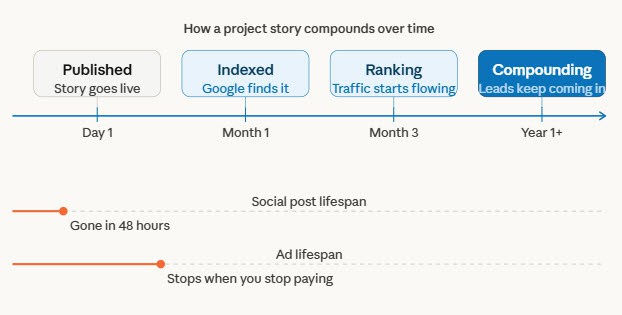
The remodelers who understand this are building something their competitors can’t easily replicate — because you can’t fake a body of real, local, specific project documentation. It takes time. It takes consistency. And it pays off in exactly the kind of high-intent, high-quality leads that high-end remodeling firms need.
What to do next
Pull up your last five completed projects. Ask yourself honestly — does Google know they exist? Not as photos in a gallery. As real, searchable, findable pages that tell the full story of what you built and where you built it.
If the answer is no, you’re leaving your best marketing asset sitting in a folder.
Your work deserves to be found. Let’s make sure it is.
Want to see what a fully produced project story looks like — and how it’s built to rank? See how I help remodelers document their best work.