
TL;DR — The quick version:
There are four ways remodelers and home builders can document completed projects, and they’re not interchangeable.
A testimonial is a short quote from a homeowner. It’s great for quick credibility but light on detail. A customer story is a full narrative told from the homeowner’s perspective. It builds emotional connection but requires an interview. A case study is data-driven and technical and is most useful for manufacturer partnerships, not typical remodeler marketing. A project story is a dedicated, SEO-optimized page on your website designed to rank on Google. It’s the only format that helps your best work be found by homeowners who don’t yet know you.
Most high-end remodelers need all four — but project stories deliver the longest-lasting return.
This article, which was originally published in 2012, has been updated to include project stories – a fourth format that’s become essential for remodelers and custom home builders who want their completed work to rank on Google.
If you’ve ever sat down to document a completed project and wondered whether to call it a testimonial, a case study, a customer story, or something else entirely, you’re not alone. Remodelers and custom home builders use these terms interchangeably all the time, and it creates real confusion about what to create, when to create it, and what it’s actually supposed to do for your business.
The truth is, these are four distinct formats — each with a different purpose, a different level of depth, and a different audience in mind. Understanding the difference helps you make smarter marketing decisions and get more mileage out of every completed project.
Let’s break them down.
The Testimonial
A testimonial is the shortest and simplest form of social proof. It’s a direct quote from a satisfied homeowner expressing their experience working with you. Typically just a few sentences, it captures appreciation and satisfaction but not much else.
Here’s what a typical remodeler testimonial looks like:
“Thank you to JL Smith Building and Remodeling for a beautiful job on our addition. Their team was professional throughout the entire process and worked around our family’s schedule without complaint. We’d highly recommend them.” — R. Hackman
Testimonials are genuinely useful — drop them on your website, include them in proposals, add them to your email newsletter. They provide quick social proof that you do good work and treat clients well.
But notice what’s missing: there’s no detail about the project itself, no sense of the challenge or the solution, no reason for a prospective homeowner to feel like their situation was understood. Testimonials tell people you’re good. They don’t show people why you’re the right choice for their specific project.
The Customer Story
A customer story — sometimes called a customer success story — goes significantly deeper. It’s a full narrative account of a real project, told largely through the homeowner’s eyes. Think of it like an article you’d find in a shelter magazine: Better Homes & Gardens, This Old House, or any HGTV feature. It has a beginning, a middle, and an end.
A well-written customer story for a remodeler typically covers:
The homeowners’ situation before the project — why their current home wasn’t working for them, what prompted them to finally make a change, and why they chose remodeling over moving. The solution your company provided — the design process, how you solved their specific challenges, what made the project interesting or complex. The outcome — not just the finished product, but how the homeowners feel about it and how it’s changed how they live in their home. Direct quotes from the homeowners throughout, in their own words.
Customer stories run anywhere from 500 to 1,500 words and work beautifully as website content, email newsletter features, and printed leave-behinds for sales presentations. They build trust by showing prospective clients what it’s actually like to work with you — and they answer the question every homeowner secretly asks: “Will they really understand what I’m trying to achieve?”
One practical note: a customer story requires your homeowner’s participation. You need to interview them, use their quotes, and tell the story from their perspective. Most satisfied clients are happy to participate — but if a homeowner is unavailable, private, or the project had some bumps, a project spotlight or project story may be a better fit.
The Case Study
A case study is the most formal and data-driven format of the four. It goes beyond storytelling to document the specific challenge, the solution, and — critically — measurable results. Case studies answer the question “how” in granular detail.
In other industries, case studies often include metrics like cost savings, efficiency gains, or performance improvements. In the construction world, they’re most commonly used by manufacturers to demonstrate how a specific product performed in a real installation — a high-efficiency HVAC system, a new building material, a structural system. A builder and a manufacturer might collaborate on a case study to show contractors and specifiers exactly how the product was installed and what it delivered.
For most remodelers and custom home builders, a traditional case study isn’t the right tool. Your homeowners aren’t looking for ROI metrics and technical performance data — they’re looking for inspiration, trust, and proof that you can execute at a high level. That’s where customer stories and project stories do the heavy lifting.
The Project Story — Built for Remodelers and Google
This is the format that’s evolved specifically for remodelers and home builders operating in a digital-first world — and the one that’s become the most valuable for search visibility.
A project story combines the narrative depth of a customer story with deliberate search engine optimization. It’s a dedicated page on your website — not a blog post, not a portfolio entry — that documents a single completed project in enough detail that Google understands exactly what you did, where you did it, and for whom.
What makes a project story different from a customer story is its structure and intent. A customer story is written primarily for the homeowner reading it.
A project story is written for two audiences simultaneously: the homeowner who’s considering hiring you and the search engine that determines whether that homeowner finds you in the first place.
A well-built project story includes:
- A specific, keyword-informed title — not “Beautiful Kitchen Renovation” but “Whole Home Addition in McLean, Virginia.” The project location is woven naturally throughout the content, reinforcing local search signals. The project type, scope, and key details are described in the language that homeowners actually search.
- Optimized photos with descriptive alt text that tells Google what it’s looking at. A URL that reflects the project — something like /project-portfolio/morgantown-kitchen-addition/.
- Internal links to your relevant service pages.
- A submission to Google Search Console after publishing so Google indexes it promptly.
The result is a page that ranks for highly specific local searches — the kind a homeowner in buying mode types when they’re 60 to 90 days from signing a contract. Someone searching “home addition contractor Northern Virginia” or “kitchen remodel before and after Reston VA” is not casually browsing. They’re actively looking to hire someone.
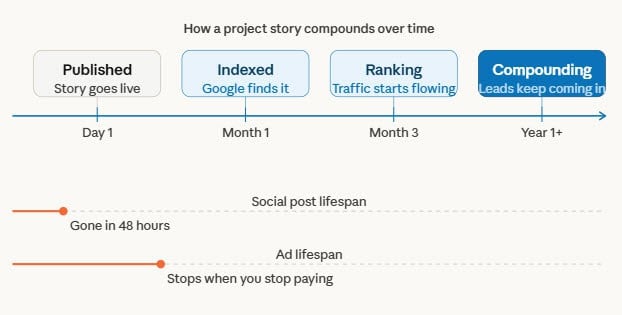
And unlike a social media post that disappears in 48 hours or an ad that stops working the moment you stop paying for it, a project story compounds over time. A page published today can still be generating traffic — and leads — three to five years from now.
Which Format Does a Remodeler Actually Need?
Here’s a plain-English guide to help you decide:
Use a testimonial when you need quick social proof for proposals, your website homepage, or marketing materials. Every completed project should generate at least one.
Use a customer story when you have a willing homeowner, a project worth celebrating in depth, and you want to build an emotional connection with prospective clients. Customer stories work especially well in email newsletters and printed marketing materials.
Use a case study when you’re working with a product manufacturer or need to demonstrate a highly technical solution to a professional audience — architects, engineers, or commercial clients.
Use a project story when you want your completed work to be found by homeowners who don’t know you yet. Project stories are the format that puts your best projects on Google and keeps them working for your business long after the job is done. For most high-end remodelers and custom home builders, this is the highest-ROI content investment available.
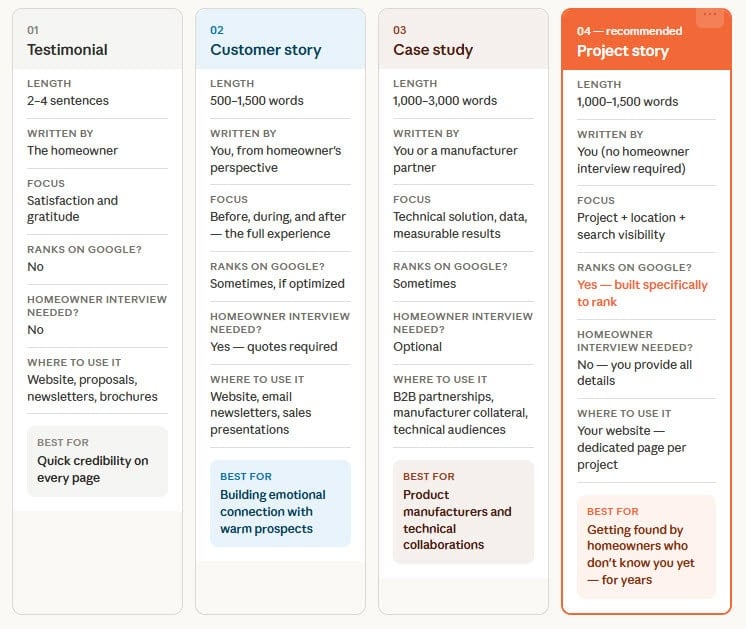
The good news: you don’t have to choose just one. Many of the best remodeling marketing programs combine all four — a testimonial for quick credibility, a customer story for depth and emotion, and a project story for long-term search visibility.
Your completed projects are your most compelling marketing asset. The format you choose determines whether that asset works for a week or for years.
Ready to put your best projects to work on Google? Learn how I help remodelers produce fully optimized project stories →