

There are more remodeling companies in America than at any point in modern history, and the number continues to climb.
The 2022 Economic Census counted 128,187 residential remodeling establishments in the U.S. Five years earlier, there were 102,818 — a 25% increase in five years. Between 2007 and 2022, the number of residential remodelers grew 73%.
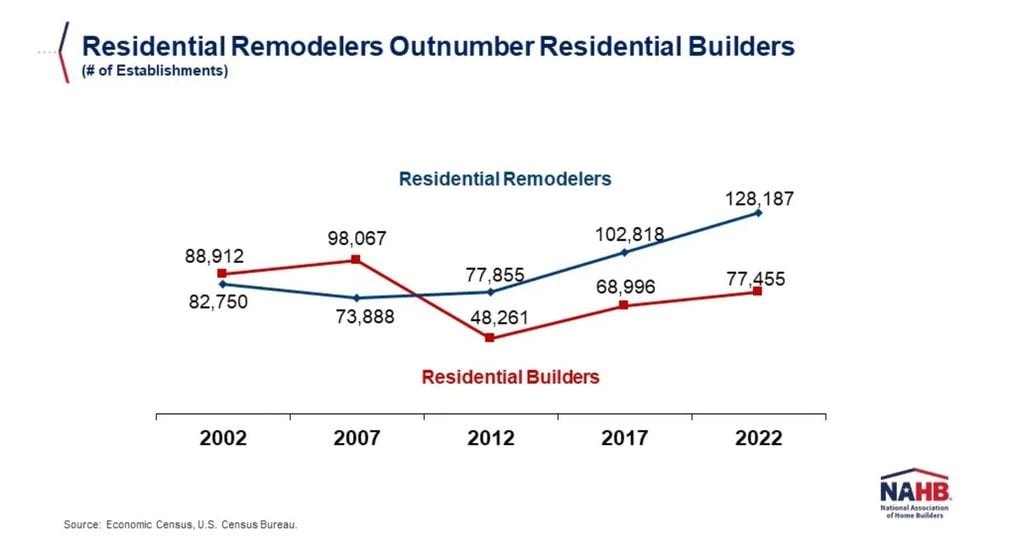
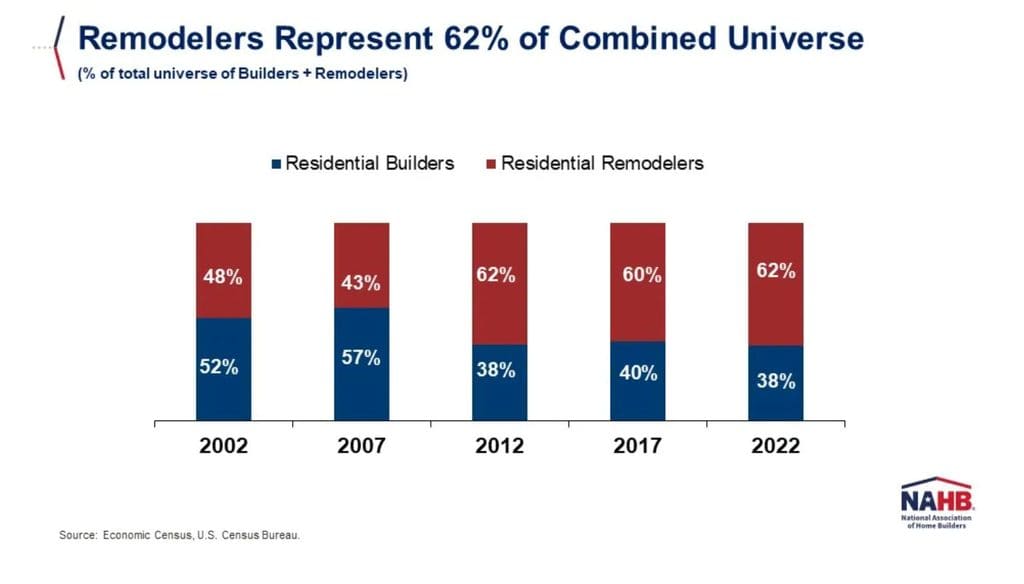
Over that same stretch, residential builders went the other direction — down 21% since 2007, from 98,067 to 77,455. Remodelers now make up 62% of the residential construction universe. The last Economic Census in which builders held the majority was 2007.
So the field didn’t just get more crowded. It shifted.
And if those stats aren’t enough to jolt you awake, here’s another one: The four largest remodeling companies in America account for 1.9% of all remodeling receipts, down from 3.3% a decade earlier. In most industries, consolidation runs the other way. Remodeling is doing the opposite.
This means that nobody is going to out-scale you. There’s no national brand coming to eat your market. But it also means the only advantage available to you is the one you build yourself — and you’re building it against 128,000 other companies who are, most of them, pretty good at what they do.
Which brings me to the thing I think most builders and remodelers get wrong about differentiation (i.e., Unique Selling Proposition) … and the topic of this week’s article.
Differentiation has rungs
When I ask a builder what makes them different, I always get an answer, one that they honestly hold as “their thing.” But it is also almost always from the bottom rung.
Here’s how I’ve come to think about differentiation.
Rung One: The Claim
“Quality craftsmanship.” “We communicate.” “We finish on time.” “We do aging in place.”
It’s like going to Cold Stone Creamery and selecting vanilla ice cream when you can have “Don’t Cry Over Spilled Milk” or “Mud Pie Mojo” – because those concoctions, when said out loud, make you stop and ask, “Well, what’s that all about?”
“Aging in place” … this one deserves a minute because it’s the one I’ve been hearing a lot lately, and it feels specific, but it’s not, at least not on its own.
NAHB’s Q1 2025 Remodeling Market Index found that 56% of professional remodelers have done aging-in-place work. Grab bars: 87%. Curbless showers: 78%. Higher toilets: 71%. Source: NAHB Poll Showing Rising Demand for Aging-in-place Remodels
More than half your competition can make the same claim you’re making. That isn’t separation. That’s the middle of the pack. But hold on, because there’s a second half to that number that changes the picture.
That 56% is the lowest reading NAHB has recorded since 2004. In 2018 it was 77%. In 2023 it was 63%. The field is quietly backing away from this work; meanwhile, the oldest boomers are turning 80, and the Gen Xers are researching solutions for a loved one, or themselves.
Here’s what I know (and where I push my clients further): Aging in place is a worthless claim because everyone has already said it. But it’s wide open as a commitment — and it gets more open every year. The gap in your market isn’t between remodelers who mention it and the remodelers who don’t. It’s between remodelers who list it as a service and those who have organized their business around it.
Rung Two: The Proof
Now show it. CAPS certification. Forty completed projects. A before-and-after with the homeowner’s name attached, along with her own words about what the process was actually like.
This is real separation, and most firms never get here. But we also need to be aware of what proof is: it’s evidence of the past, and yes, it’s copyable. Your competitor can get certified this year and be even with you by spring.
That’s why the differentiator rung doesn’t stop at proof.
Rung Three: The Commitment
This is where it gets interesting … and can even be fun. And it’s where the dogs come in.
What if you are known for how you handle pets during a remodel? Not “we’re pet friendly” (because anyone can claim that), but you have an actual protocol.
- You ask where the dog sleeps before you ask about the tile.
- You know which room is hers, and you seal it differently.
- You tell the family a week ahead which day(s) it’s going to get a bit loud, so they can board her or plan around it.
- Your crew knows her name.
- … and the cat that hides in the basement for three weeks, you know about her, and you’ve made sure she stays safe too.
That’s rung three, a real commitment. And here’s why I put it there: it costs you something.
Your commitment to the pets is operationally inconvenient. It slows a crew down on a Tuesday. You had to train people on it, and you have to keep training people on it.
That cost is the entire point. A claim is free, so everyone makes it. Proof is cheap, so anyone can buy. But a commitment is expensive, so almost nobody copies it. Not because they can’t, but because they won’t want it badly enough to absorb the cost.
Notice what it does to the sale. A homeowner choosing among three firms who has a twelve-year-old lab is no longer comparing your tile allowance to anyone else’s. You’ve moved the conversation from a project to being human … and what matters to them.
Rung Four: The Identity
The realtor who sold our house in Washington gives a percentage of every commission she and her team earn back to the community. Over the years, it’s added up to over $365,000!!
Here’s why it made an impression on me: she isn’t doing it as a marketing strategy. She’d do it even if it never brought her a single listing. It’s who she is, and the marketing is downstream of the fact.
That’s rung four, and it’s the only rung that can’t be reverse-engineered. You can’t decide to have an identity. You can only notice the one you already have and stop being shy about it.
Most of the builders I work with are already standing on rung four somewhere in their business. They just don’t think of it as marketing, so they never say it out loud.
- The Refusal. A design-build firm that only takes eight projects a year, but not because that’s capacity. Why? The owner decided a long time ago that nine means he stops knowing every homeowner’s name and giving them the personalized attention he’s proud of. He turns down work every month, and he’s turned down work in bad years.
- The People. The builder who has never laid anyone off. He carried the whole crew through 2009 on a personal line of credit and finished paying it back in 2014. He didn’t do it for any other reason than that he couldn’t face sending them home during the really hard time. As a result, he has a crew with 15 years of tenure that his competitors cannot assemble at any price.
- The Conviction. A remodeler who deconstructs instead of demolishes. Cabinets, fixtures, doors, and trim are carefully removed and donated to the Habitat ReStore. It adds hours to every job (and he eats them), because putting a functional kitchen into a dumpster makes him sick, and it always has.
The Path to Your Differentiator
Think about this question:
What do you do for your clients that costs you real time or money, and that you’ve never once thought of as marketing?
Then get a second opinion from the only people whose opinions matter: your past clients. Copy your Google reviews (all of them) and paste them into ChatGPT with this:
Below are the Google reviews for my remodeling company. I want to find my actual differentiator, so be rigorous rather than flattering.
- First, list the themes that show up in most of the reviews. Label these “table stakes” — assume my competitors’ reviews say the same things.
- Then find the outliers: specific details mentioned by only one or two people, especially anything unusually vivid, oddly precise, or emotional. These matter more than the common themes.
- Quote their exact words. Don’t paraphrase and don’t clean up the phrasing.
- Last: what did a reviewer clearly not expect? Surprise is the strongest signal.
Don’t tell me what I want to hear. If these reviews suggest I have no meaningful differentiator, say so.
Watch for the outliers, not the themes. Most reviews say “great communication, on time, clean job site” — that’s rung one. But when somebody writes, “they found rot behind the shower and called me before they touched anything — sent photos, walked me through three options, and never once made me feel stupid for not knowing it was there” — that’s not a compliment. That’s something that surprised her.
Surprise is the signal, but the review isn’t your differentiator. It’s evidence that one exists. Ask yourself what you did that made her write that sentence. That answer is your Rung Three.
And if 25 people wrote about you and not one of them mentioned anything specific, that’s also a finding.
BONUS TIP: Then, before you send your next proposal, add a paragraph describing that thing, in plain language, the way you’d explain it to a neighbor. Most bids in this business are a scope and a number. Yours will have a paragraph nobody else’s has.